How AI Search Learns Which Brands to Recommend
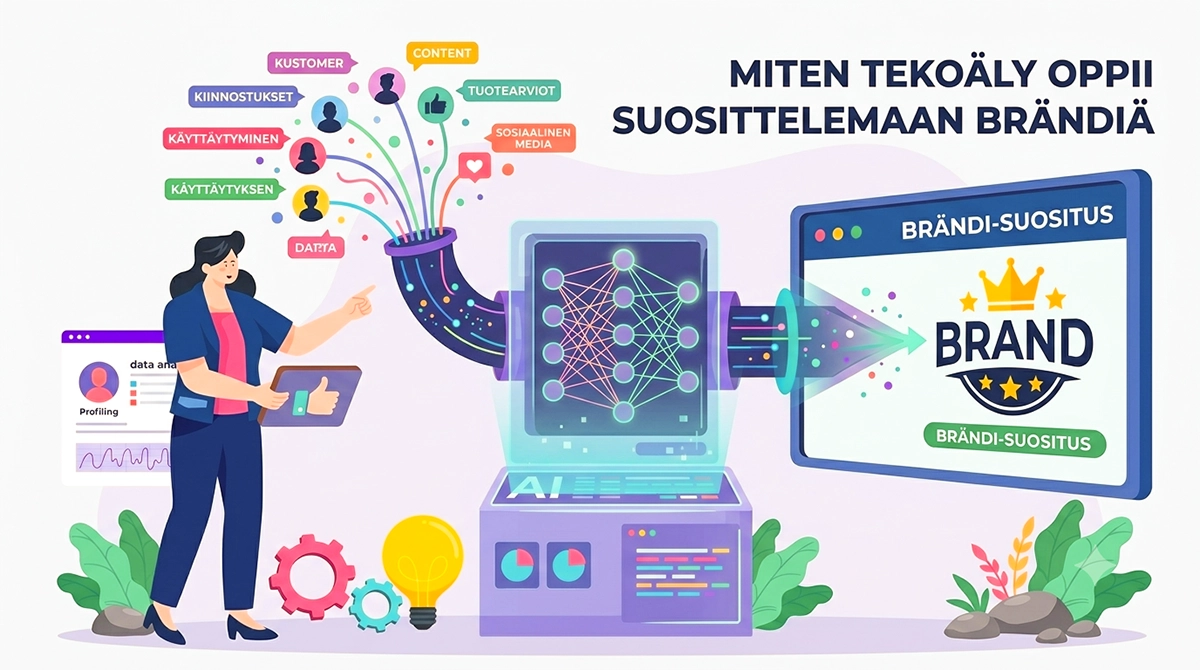
AI systems recommend brands when they can connect a company with a specific service, customer need, location, expertise, and credible evidence. These connections may come from training data, real-time web search, the company’s own website, structured information, customer reviews, independent articles, and other sources that consistently describe what the brand does.
When someone asks ChatGPT, Perplexity, Gemini, Claude, or Grok to recommend a company, the system does not simply open a traditional search ranking and copy the first three results.
An AI-generated recommendation may involve several separate stages. The platform may interpret the user’s intent, decide whether current information is required, create one or more search queries, retrieve relevant sources, select useful passages, compare possible answers, and then generate a response.
This is why one business may appear frequently in AI recommendations while another company with a strong traditional search presence remains unmentioned.
At AEOvara, I examine this process through AEO, GEO, LLMO, source analysis, structured content, and repeated AI visibility testing. The objective is not to claim that businesses can control language models. The objective is to understand which parts of brand visibility can genuinely be improved and which parts remain outside the company’s control.
AI Brand Recommendations Are Not Based on One Ranking Factor
There is no publicly confirmed universal score that determines which company an AI platform recommends. Brand selection is more accurately understood as the result of multiple information and retrieval signals working together.
A recommendation may be influenced by factors such as:
- how closely the company matches the user’s actual request
- whether the company is clearly associated with the relevant service
- the user’s location and language
- the freshness and accessibility of available information
- the quality and relevance of retrieved sources
- the consistency of the company’s online identity
- independent reviews, discussions, comparisons, and references
- whether the AI platform activates real-time web search
A business should therefore avoid treating AI visibility as a technical shortcut. Adding one schema type, publishing one article, or receiving one Reddit mention does not automatically teach every language model to recommend the company.
AI visibility develops through a wider information environment in which the brand is repeatedly and accurately connected with the right subject.
Training Data and Real-Time Search Work Differently
A language model’s existing knowledge and an AI platform’s real-time web search are two different sources of information. Understanding this difference is essential when evaluating brand recommendations.
Information learned during model training
Large language models are trained using broad collections of text. Depending on the developer and model, these collections may include public web content, licensed material, human-created training examples, and other datasets.
During training, the model learns statistical relationships between words, concepts, organizations, people, services, and topics. The model does not store a simple business directory in which every company has a fixed recommendation score.
If a brand appears repeatedly in relevant contexts, the model may develop a stronger association between that brand and a particular topic. The exact influence of an individual web page, review, forum discussion, or article is usually not publicly known.
Information retrieved during live search
Modern AI platforms can also search for information when the user asks a question. This search may happen through the platform’s own index, a search partner, or an integrated web search system.
The AI system may transform the user’s question into several more specific searches. It may then retrieve pages, extract relevant sections, and give those sections to the language model as additional context.
This process is commonly associated with retrieval-augmented generation, or RAG.
A training-data-based answer may reflect information learned months or years earlier. A search-grounded answer may use information discovered at the exact moment the question is asked.
This distinction explains why updating a company website does not instantly update what every language model already “knows.” The new information can still become available to search-based AI systems after the page is crawled, indexed, and selected as a relevant source.
What Sources Can Influence an AI Recommendation?
AI platforms may use several types of sources when answering company recommendation questions. The exact source selection differs between platforms, prompts, markets, and individual searches.
Potential sources include:
- company service pages
- pricing and comparison pages
- expert and author profiles
- customer case studies
- local business listings
- review platforms
- news articles and interviews
- professional publications
- podcasts and transcripts
- Reddit and other public discussions
- partner and customer websites
- industry reports and original research
The company’s own website remains a central source because it defines the basic facts of the business. A clear website should explain the company’s services, location, customers, specialists, processes, pricing principles, experience, and differentiating factors.
However, a company website is a first-party source. A business can make almost any claim about itself.
Independent sources can strengthen those claims by showing that customers, journalists, partners, researchers, or industry professionals associate the brand with the same expertise.
Brand Context Matters More Than Repeating a Brand Name
Brand context describes the wider meaning surrounding a company’s name across the web. It answers the question: what does the internet consistently associate this brand with?
A company name may appear hundreds of times online without creating a useful professional association. Mentions become more valuable when they connect the brand with a clear service, problem, audience, location, result, or area of expertise.
A strong brand context may connect a company with:
- a defined professional category
- a specific geographic market
- recognizable experts
- customer problems the company solves
- documented experience and case studies
- independent customer feedback
- original research or analysis
- consistent terminology across several sources
For example, a company cannot build a credible association with Answer Engine Optimization only by adding the phrase “AEO expert” to a homepage.
A stronger association develops when the company also publishes detailed AEO content, explains its methodology, presents real tests, creates original research, documents client cases, receives relevant external mentions, and identifies the experts responsible for the work.
The goal is not to manufacture mentions. The goal is to make genuine expertise visible and verifiable.
How Website Structure Supports AI Visibility
A well-structured website makes information easier for both people and machines to locate, understand, and reuse. This does not guarantee inclusion in an AI response, but it reduces unnecessary ambiguity.
Important pages should provide direct answers to questions such as:
- What does the company do?
- Who is the service intended for?
- Which geographic area does the company serve?
- Who provides the service?
- What is included in the service?
- How much does the service cost?
- How does the service differ from alternatives?
- What evidence supports the company’s claims?
Each important section should begin with a concise answer before moving into a longer explanation. This structure supports AEO, or Answer Engine Optimization, because the essential answer can be understood even when it is extracted from the surrounding page.
GEO, or Generative Engine Optimization, expands the focus to visibility inside generative answers. GEO examines whether a source, passage, brand, or expert is likely to be retrieved, used, summarized, cited, or mentioned by an AI-powered system.
LLMO, or Large Language Model Optimization, is often used as a broader term for improving how language models can discover and interpret a company’s content and identity.
These areas overlap with traditional SEO, but they also introduce a new question: is the information easy to reuse inside an answer, not only easy to rank as a link?
Schema Markup Reduces Ambiguity but Does Not Guarantee Visibility
Structured data can help search systems understand the entities and relationships described on a page.
Relevant schema types may include:
- Organization
- LocalBusiness
- Person
- Service
- Article
- BreadcrumbList
- Review
- FAQPage when appropriate and supported
Schema can clarify that Jarno Saarimies is a person, AEOvara is an organization, a page describes a particular service, and an article was written by a named specialist.
This can support machine understanding and entity recognition. It does not force an AI platform to recommend the company.
Schema should always match the visible page content. Adding unsupported awards, ratings, credentials, or services to structured data weakens trust instead of strengthening it.
Independent Evidence Supports E-E-A-T
Experience, Expertise, Authoritativeness, and Trustworthiness provide a useful framework for evaluating whether a company and its content appear credible.
Experience
First-hand experience becomes visible through real cases, practical examples, original tests, documented methods, client work, and observations gathered through actual projects.
Expertise
Expertise appears when an author can explain a topic accurately, distinguish between related mechanisms, provide useful examples, and acknowledge uncertainty where reliable information is not available.
Authoritativeness
Authority grows when other relevant sources recognize the person or organization. Interviews, professional references, research citations, partnerships, event appearances, and industry publications can support this recognition.
Trustworthiness
Trust depends on whether claims can be verified. Clear authorship, transparent methodology, source references, accurate company information, realistic promises, and openly stated limitations all strengthen trust.
E-E-A-T should not be treated as a single numerical score. It is a practical way to evaluate whether the company’s digital presence provides enough evidence for readers and information systems to take its claims seriously.
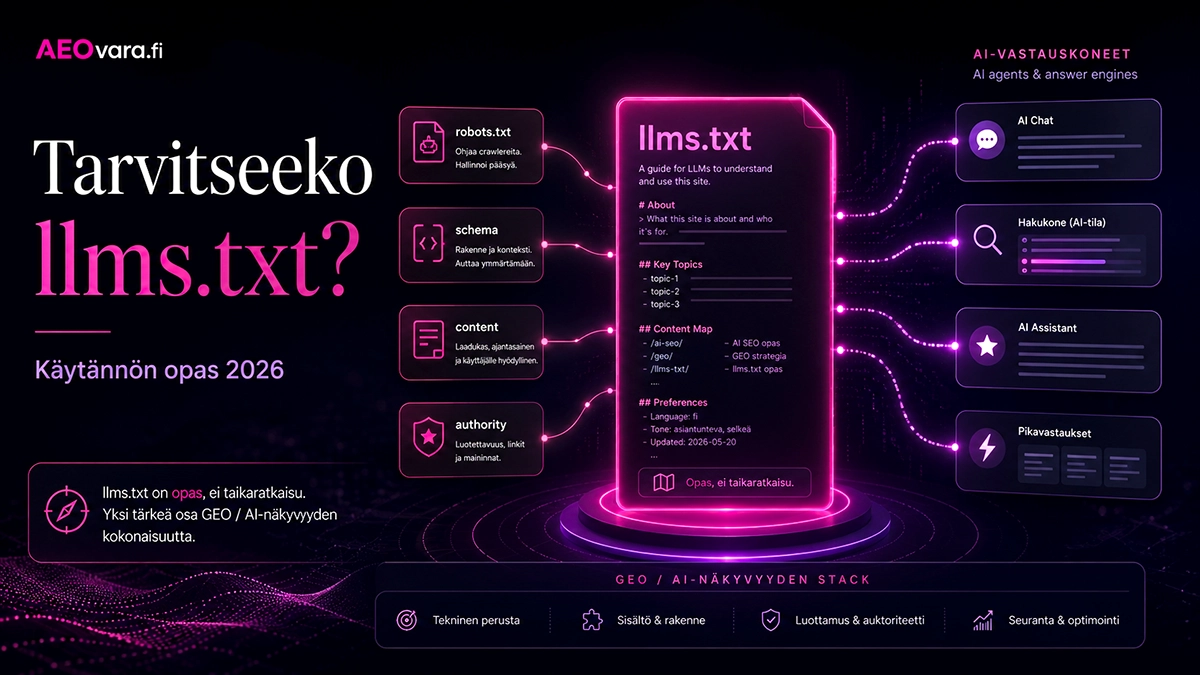
Can llms.txt Help a Brand Become Recommended?
llms.txt is a proposed text-based file that can provide AI tools with a simplified map of a website’s important content.
The concept may be useful as an additional content discovery layer. A well-created llms.txt file can point toward important services, guides, expert pages, research, and documentation.
However, llms.txt is not a universally confirmed AI recommendation factor. A business should not expect a language model to begin recommending the brand simply because the file exists.
I consider llms.txt a supporting experiment rather than the foundation of AI visibility.
The stronger priorities remain:
- accessible and crawlable pages
- clear and accurate content
- consistent brand information
- useful structured data
- strong internal linking
- independent external evidence
- real expertise and original information
Why Different AI Platforms Recommend Different Companies
ChatGPT, Perplexity, Gemini, Claude, and Grok can produce different company recommendations because they do not use identical models, search tools, indexes, or source-selection processes.
Differences may result from:
- different search indexes and partners
- different ways of rewriting the original query
- different freshness requirements
- different geographic and language signals
- different rules for deciding when to browse
- different methods for filtering retrieved sources
- different access to social or community content
- different conversation context
A company may therefore appear frequently in Perplexity while remaining largely absent from Gemini. The same company may be mentioned in ChatGPT for educational questions but not for commercial recommendation prompts.
AI visibility should be evaluated across several platforms instead of treating one ChatGPT answer as a universal result.
Share of Model Measures the Pattern, Not One Screenshot
Share of Model measures how visible a brand is across a controlled group of AI prompts and platforms.
A Share of Model analysis may track:
- how often the brand is mentioned
- which questions produce a mention
- where the brand appears in the answer
- which competitors are recommended
- which attributes are connected with the brand
- which sources are cited
- whether the mention is positive, neutral, or negative
- how the results change over time
One successful result is not enough to prove stable AI visibility. Answers may change because of wording, timing, user location, browsing mode, conversation history, or normal variation in generated responses.
A reliable measurement process uses a repeated prompt set and compares results over time.
Seven Practical Ways to Improve AI Brand Visibility
- Define the brand consistently. Use the same company name, service descriptions, expert names, location, and key facts across the website and relevant external profiles.
- Answer real customer questions. Publish clear information about pricing, suitability, processes, comparisons, risks, results, and selection criteria.
- Demonstrate real experience. Use case studies, original research, documented tests, practical examples, and transparent methodology.
- Improve technical accessibility. Check robots.txt, noindex settings, server restrictions, JavaScript rendering, canonical tags, and access for relevant search crawlers.
- Use structured data accurately. Connect the company, experts, services, articles, and locations using schema that matches the visible content.
- Earn independent references. Build genuine reviews, interviews, citations, partnerships, customer references, and relevant professional mentions.
- Measure Share of Model repeatedly. Test several platforms, languages, prompt variations, and dates. Track changes instead of relying on individual answers.
Transparency Is Part of AI Search Expertise
AI companies do not publish every detail of their training data, retrieval systems, source rankings, or recommendation logic.
Responsible AEO, GEO, and LLMO work should therefore distinguish between:
- information confirmed by official documentation
- results reported in research
- practical observations from controlled tests
- assumptions that have not yet been verified
A correlation should not be presented as proof of causation. A successful test should not automatically be described as a universal ranking factor. A technical improvement may support discovery without guaranteeing that an AI system will mention the brand.
In my view, trustworthy AI visibility work does not promise certainty where certainty does not exist. It improves the probability that a company can be discovered, understood, verified, and considered relevant.
Final Summary
- AI recommendations can use both training data and real-time web search.
- Clear website content helps, but independent sources strengthen the brand’s credibility and context.
- AEO, GEO, schema, llms.txt, and technical accessibility support different parts of the visibility process.
- Share of Model should be measured across several prompts, platforms, and time periods.
- No single optimization guarantees that an AI platform will recommend a specific brand.
Originally Published by AEOvara
This article expands on my original Finnish-language analysis, “Miten tekoäly oppii suosittelemaan brändiä”, published on the AEOvara website.
Read the original source-based article: https://aeovara.fi/miten-tekoaly-oppii-suosittelemaan-brandia/
About the Author
I am Jarno Saarimies, also known as Jarno.S, an AEOvara specialist working with SEO, Answer Engine Optimization, Generative Engine Optimization, LLMO, AI search visibility, and Share of Model analysis.
My work focuses on understanding how companies and experts appear in AI-generated answers, which sources different AI platforms use, and how brand visibility can be improved through structured content, technical accessibility, independent evidence, and transparent measurement.
Learn more about AEOvara: https://aeovara.fi/